
Our APPROACH

Environment
‍

Our responsible approach to solar development

Since beginning development in 2025, RIC Energy is looking forward to worrking with the Town of Schroeppel to begin detailed site plan review. The Project has completed all necessary environmental surveys.
‍

Landowner hardship waiver
Requested/pending
SEQR environmental review
In progress
Special Use Permit
Pending
Site plan approval
Pending
Technical and environmental studies
Completed
agrivoltaics at schroeppel solar project

Keeping a quiet presence

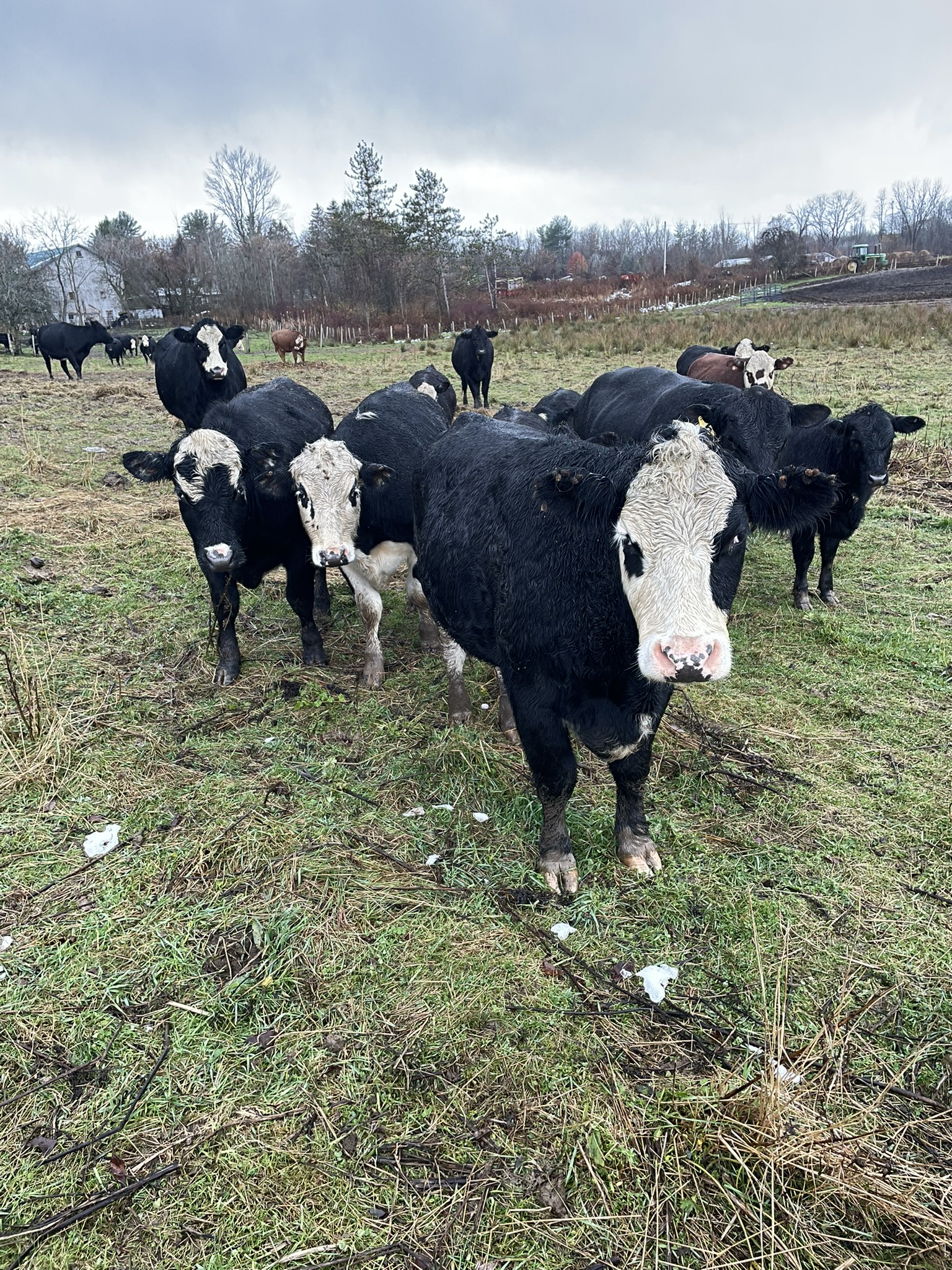
cattle grazing alongside solar energy production

The project is located on active farmland used for hay and cattle. It has been designed to allow cattle grazing to continue alongside the solar equipment. This practice, known as agrivoltaics, allows solar energy production and agriculture to occur on the same land.

The solar project will provide supplemental lease income to help sustain the Whitney family’s farming operations, which have continued on the property since the 1940s. This additional income will help support the farm as farming costs continue to rise.

At the end of the project’s operational life, the land will be restored for future agricultural use, helping preserve its long-term productivity for generations to come. Image: Family photo of the Whitney family farm

Visual aesthetics

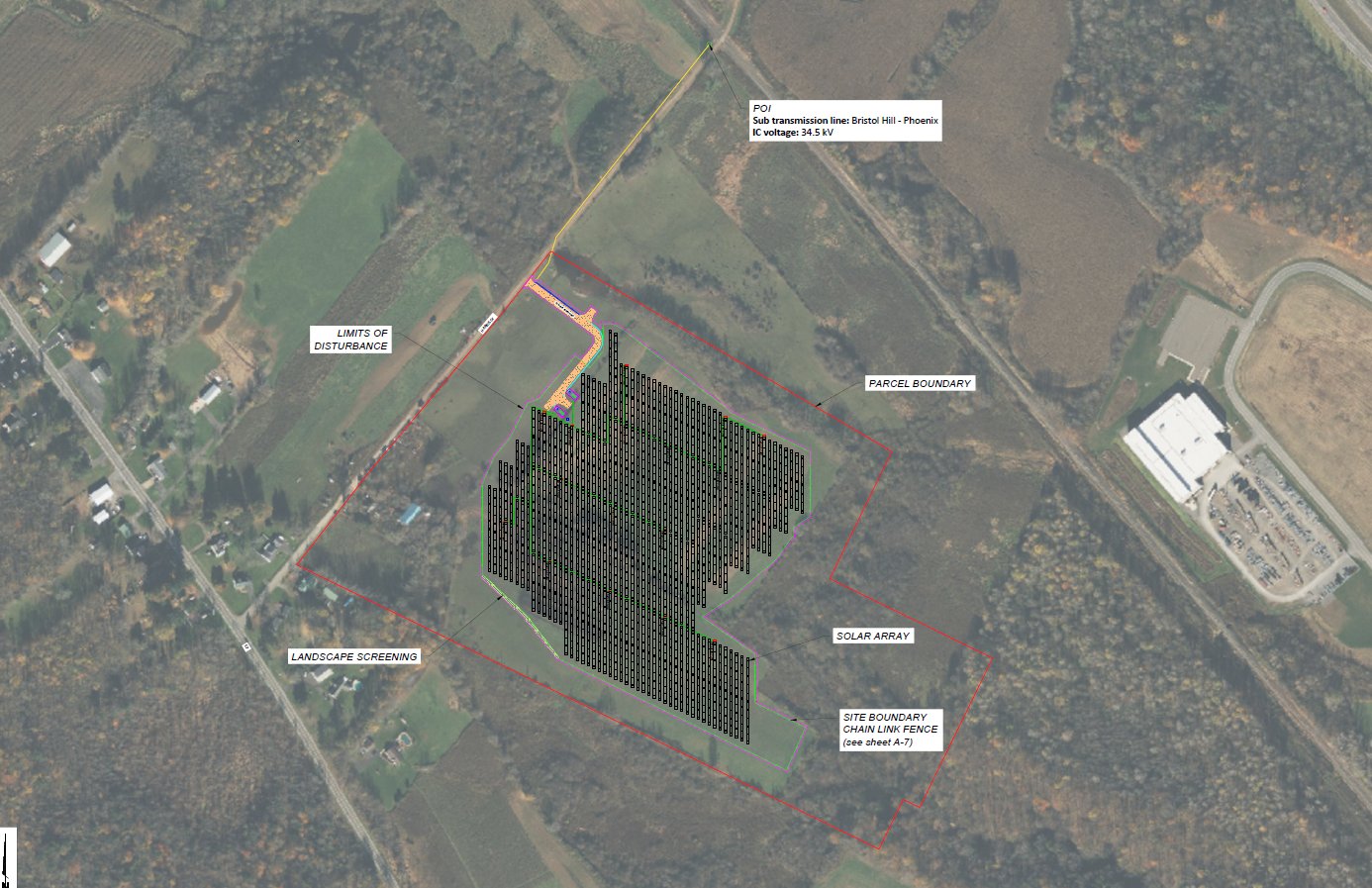
A Visual Impact Assessment (VIA) has been completed. The project will be situated more than 700 feet from County Route 57 and screened by existing vegetation and additional landscaping. Approximately 100 new trees will be planted around the perimeter fence where the project would otherwise be visible to neighboring residents. These measures are designed to make the project virtually invisible from public view.
CONSTRUCTION TIMELINE

Installation Process and Proper Maintenance

The tentative construction schedule assumes that mobilization and construction would commence 2-4 weeks after a building permit is approved. The expected overall timeline for construction and commissioning is approximately 18-20 weeks.

Construction is generally divided into several phases:

01
Mobilization
1 Week
Mobilization of construction crews and delivery of initial construction equipment.
02
Site Preparation
and Civil Work
3 Weeks
This phase starts with the implementation of erosion and sedimentation control measures being put in place prior to the start of construction. It continues with clearing and grading as well as the construction of the driveway and interior access road for the Projects.
03
Mechanical
installation
10 Weeks
This phase includes the installation of solar racking, which for this project is a single-axis tracker. The installation begins with post-driving, which is the only type of construction work that will generate higher noise levels but is limited only to 1-2 weeks and will be conducted within regular working day hours, to not cause any significant disruption to neighbors.

The rest of the activities include installation of the solar trackers, PV modules, inverters, transformers, etc. None of these activities generate any excessive noise, dust, or other forms of disturbance to the surrounding neighbors.
04
Electrical
installation
6 Weeks
Electrical work includes the installation of underground cables, wiring and termination of above ground cables on the solar trackers (connecting all modules into strings and connecting them to the inverters), wiring and termination of grid interconnection facilities.
05
QA/QC
inspections and
Commissioning
Regular quality assurance and stormwater management inspections will be implemented throughout the construction and installation period. Once all systems are installed and connected, a dedicated third-party engineering crew, along with the utility’s engineers, will conduct the final inspections and testing procedures before the system can be placed into operation and start generating and exporting energy into the grid.
01
Mobilization
1 Week
Mobilization of construction crews and delivery of initial construction equipment.
02
Site Preparation
and Civil Work
3 Weeks
This phase starts with the implementation of erosion and sedimentation control measures being put in place prior to the start of construction. It continues with clearing and grading as well as the construction of the driveway and interior access road for the Project.
03
Mechanical
installation
10 Weeks
This phase includes the installation of solar racking, which for this project is a single-axis tracker. The installation begins with post-driving, which is the only type of construction work that will generate higher noise levels but is limited only to 1-2 weeks and will be conducted within regular working day hours, to not cause any significant disruption to neighbors.

The rest of the activities include installation of the solar trackers, PV modules, inverters, transformers, etc. None of these activities generate any excessive noise, dust or other forms of disturbance to the surrounding neighbors.
04
Electrical
installation
6 Weeks
Electrical work includes the installation of underground cables, wiring and termination of above ground cables on the solar trackers (connecting all modules into strings and connecting them to the inverters), wiring and termination of grid interconnection facilities.
05
QA/QC
inspections and
Commissioning
Regular quality assurance and stormwater management inspections will be implemented throughout the construction and installation period. Once all systems are installed and connected, a dedicated third-party engineering crew, along with the utility’s engineers will conduct the final inspections and testing procedures before the system can be placed into operation and start generating and exporting energy into the grid.
Environment
‍

Technical and environmental surveys

Wetland survey
This project is compliant with all state and federal wetlands regulations.
Compliant
Water resources
This project avoids all state and federal waterways.
Compliant
Wildlife habitat survey
This project has no habitat impacts.
Compliant
Floodplain impact
There are no floodplain impacts.
Compliant
Stormwater Management Plan
This project complies with Department of Conservation (DEC) requirements.
Compliant
PROJECT MANAGEMENT

Operation and maintenance

The solar array, inverters, transformers, and all safety systems are fully automated and remotely monitored 24/7 through an electronic system and do not require constant on-site supervision or manual operation. As described below, the Project requires only periodic inspections, servicing, and maintenance, conducted by dedicated crews, per schedule or as needed.

Beyond the construction period, the Project requires very minimal on-site personnel. Regularly occurring management operations include landscaping (solar grazing, mowing, and vegetation management) and annual inspections of the mechanical and electric installations and equipment. All these operations are performed by small crews and do not generate notable noise or traffic that is uncommon for an agricultural-residential or residential neighborhood.


During its normal operation, the solar installation:
  • Will not generate significant vehicle traffic
  • Will not generate any gas emissions
  • Will not pose a risk of any contamination of air, soil, or water resources
  • Will not generate waste
  • Will not require discharge of wastewater
  • Will not generate noise that would exceed the accepted standards
Project Decommissioning

A responsible return to its orginal state

Solar panels available on the market today are typically designed to last for at least 25 - 30 years and the Project will continually maintain the solar arrays and related equipment for the life of the Project. At the end of their useful life, the Project may be renewed or they may permanently cease operations, at which time the Project removal plan (approved by the Town of Schroeppel will be implemented to remove, reuse, and/or recycle equipment and related materials to return the Project area to its pre-construction condition so that it is available for agriculture and other open space usages as determined by the landowner at that time.

The removal of the Project is, in many ways, the reverse of its construction. Much of the same equipment that was used in the construction of the Project, such as trucks and backhoes, will again be used in the removal of the components. Steel, cable, and concrete will be removed and transported off-site for recycling and/or disposal at approved facilities. Licensed off-site disposal facilities will be identified at that time, as the availability of facilities is likely to change in the decades during the Project’s useful life. The removal of the facility and the site restoration are guaranteed through a bond, whereby the Town of Schroeppel is the beneficiary. It is also important to mention that it is in the interest of the Project to recycle the bulk of the materials and equipment, which are projected to have a higher salvage value than the total cost of the removal and restoration.